In this article
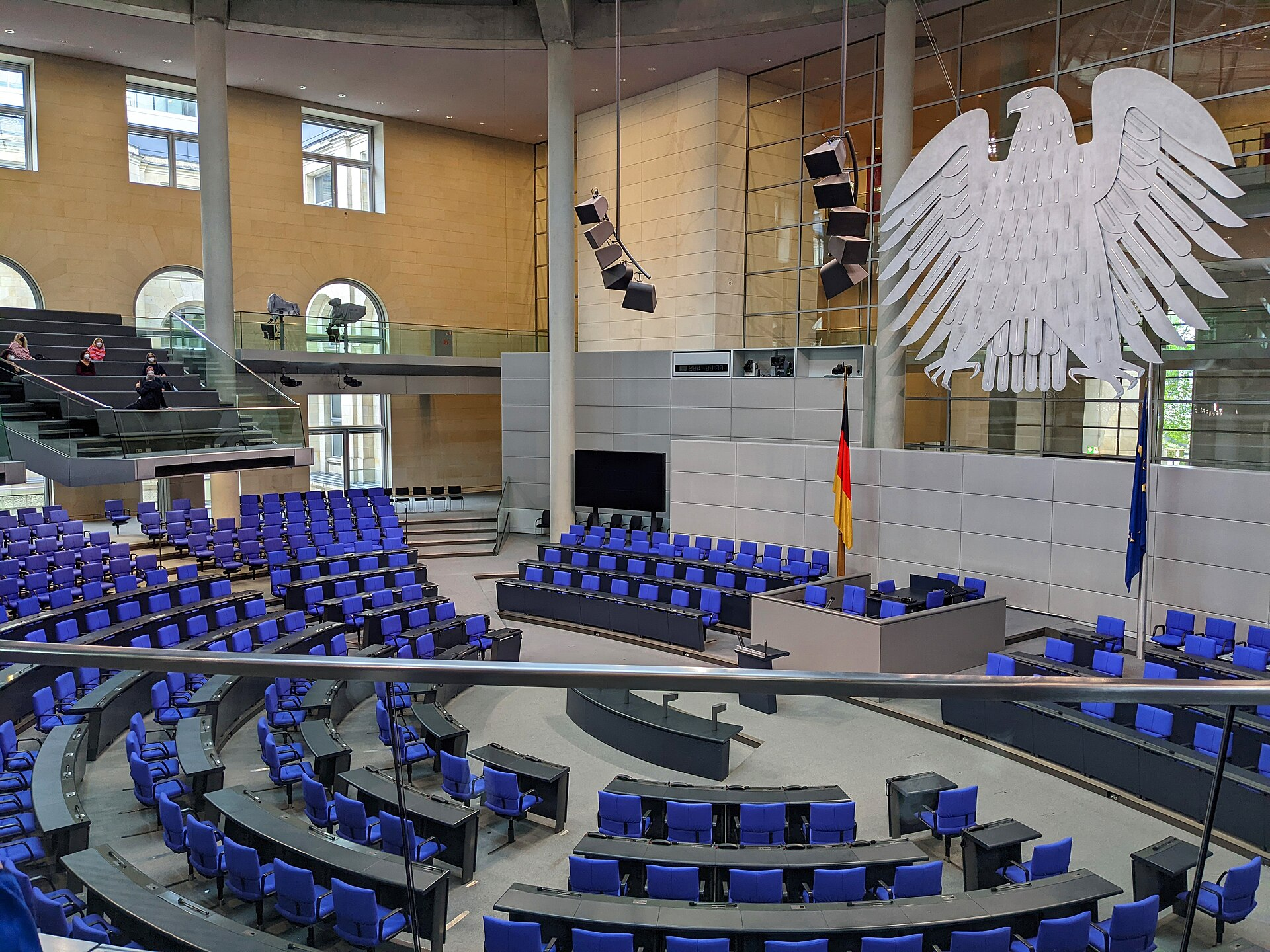
On Thursday 12 November the Bundestag takes its final vote on ratifying the EU–Mercosur Partnership Agreement, the treaty that would replace the interim trade deal under which German exporters and farmers already trade.
Foreign Minister Johann Wadephul (CDU, Schleswig-Holstein) opened the first reading on 7 October. The Foreign Affairs Committee, chaired by Armin Laschet (CDU, North Rhine-Westphalia), recommends adopting the government's bill unchanged.
The Bundestag votes on the member-state half of the deal
The bill, Drucksache 21/8240, has two articles. Article 1 approves the agreement signed in Asunción on 17 January 2026, which Germany signed in Brussels on 25 March. Article 2 sets the date it takes effect.
The deal comes as two treaties. The interim trade agreement holds the trade and investment rules that fall to the EU alone. The partnership agreement adds political dialogue and cooperation on crime, climate and tax, and those member-state matters require a treaty law under Article 59(2) of the Basic Law, the government's memorandum says. Once the partnership agreement enters into force, it replaces the interim agreement, which Thomas Rachel (CDU, North Rhine-Westphalia), the CDU/CSU rapporteur, told the House has applied provisionally since 1 May.
The Bundestag's agenda gives the item 30 minutes of debate from 17:30, followed by the second reading and final vote. It schedules no roll-call vote on the item, unlike the two Bundeswehr mandates on the same week's agenda.
Three committees, one split
The three committees that examined the bill split the same way, CDU/CSU, SPD and the Greens for and AfD and Die Linke against, according to the Foreign Affairs Committee's report of 14 October.
The government's figures in the bill:
- EU–Mercosur trade exceeded €110 billion in 2024, and €28 billion of it (16%) was German;
- more than 12,500 German companies export to the region, most of them small and medium-sized;
- more than 91% of EU exports to Mercosur become duty-free over 15 years;
- the EU removes tariffs on 95% of its tariff lines when the agreement takes effect, and forgoes an estimated €330 million in customs duties by full implementation after 15 years.
The Bundesrat must consent, because Article 8.4 of the agreement touches income and corporate tax, whose revenue the federation shares with the Länder. Consent takes 35 of the Bundesrat's 69 votes.
Industry expects gains; the AfD speaks for farmers
Wadephul said machinery, the car industry and chemicals in particular would benefit, and pointed to rare earths from Brazil and copper from Argentina. He told the House on 7 October: "Seit gut 150 Tagen wird der Handelsteil vorläufig angewandt und bringt seitdem ganz reale Erleichterungen für unsere Wirtschaft" (the trade part has been provisionally applied for a good 150 days and has since brought very real relief for our economy). He said EU exports to Brazil rose almost 12% year on year in August 2026.
Rachel told the House the agreement would save companies about €4 billion a year in tariffs. The agreement also bars export duties, in principle, after a three-year transition, which matters to buyers of South American raw materials.
Tobias Teich (AfD, Bavaria) cited quotas of 99,000 tonnes of beef at a 7.5% tariff and 180,000 tonnes of duty-free poultry, and said of the promised protections: "Solange die versprochenen Schutzklauseln nicht selbstständig und unmittelbar greifen, sind sie letztlich nur geduldiges Papier" (as long as the promised safeguard clauses do not apply automatically and immediately, they are ultimately just words on paper).
Two court cases and the Länder stand in the way
The first risk sits in court. The European Parliament asked the EU Court of Justice on 21 January 2026 for an opinion on whether both agreements are compatible with the EU treaties. Poland filed an annulment action and an application for interim relief, dated 10 May 2026, against the Council's 9 January decision to sign and provisionally apply the interim agreement. On 29 September the Court's Vice-President dismissed Poland's application for interim relief, finding that Poland had not shown the interim agreement would cause serious and irreparable harm, so the interim agreement continues to apply provisionally. Poland's annulment action (C-460/26) and the Parliament's request for an opinion (Opinion 1/26) are still pending.
Gökay Akbulut (Die Linke, Baden-Württemberg) told the House on 7 October: "Die Bundesregierung bringt heute ein Abkommen ein, dessen Rechtmäßigkeit aktuell vom Europäischen Gerichtshof überprüft wird" (today the federal government is introducing an agreement whose lawfulness is currently under review by the European Court of Justice). Wadephul said the government had told the court it considers the agreement compatible with the treaties.
The second is the Länder. The Bundesrat raised no objections at first passage on 25 September. Each Land must cast its votes as a bloc, and the Bundesrat notes that an abstention works like a no.
The third is the other capitals. Full entry into force needs ratification by every EU member state and all four Mercosur states. Metin Hakverdi (SPD, Hamburg) listed objections from France, Italy, Poland, Austria and Hungary.
If the Bundestag adopts the bill, it goes to the Bundesrat for consent, and the agreement takes full effect only after the European Parliament consents, the Council concludes it and every EU and Mercosur state ratifies.
What to watch
- 12 November, 17:30: the Bundestag's second reading and final vote on Drucksache 21/8240.
- 20 November: the Bundesrat's 1070th plenary; its draft agenda of 3 November does not list the Mercosur law, and items can be added until the sitting opens.
- 18 December: the Bundesrat's last plenary of 2026.
Follow this file through the Bundestag and the Bundesrat on PoliData.
Cite this article
PoliData (7 November 2026). Bundestag votes on EU–Mercosur ratification on 12 November. https://www.getpolidata.com/blog/bundestag-mercosur-vote-2026-11-12
<a href="https://www.getpolidata.com/blog/bundestag-mercosur-vote-2026-11-12">Bundestag votes on EU–Mercosur ratification on 12 November</a> (PoliData)
Get alerts before a bill moves.
Watchlists, keyword alerts, and plain-English summaries across six parliaments, with source-linked updates delivered to your inbox.